
News
OSPREY Registry Interim Results Presented at ESGE Days 2026
Sydney, Australia – 15 May 2026 : OncoSil Medical Limited (ASX: OSL) (“OncoSil Medical” or “the Company”), a medical device company focused on localised treatments for patients with unresectable locally advanced pancreatic cancer (LAPC), is pleased to announce that interim results from the ongoing OSPREY Registry were presented at ESGE Days 2026, highlighting encouraging safety and efficacy outcomes for patients with unresectable LAPC treated with OncoSil™ in routine clinical practice. This initial data was previously announced to ASX on 3 December 2025.
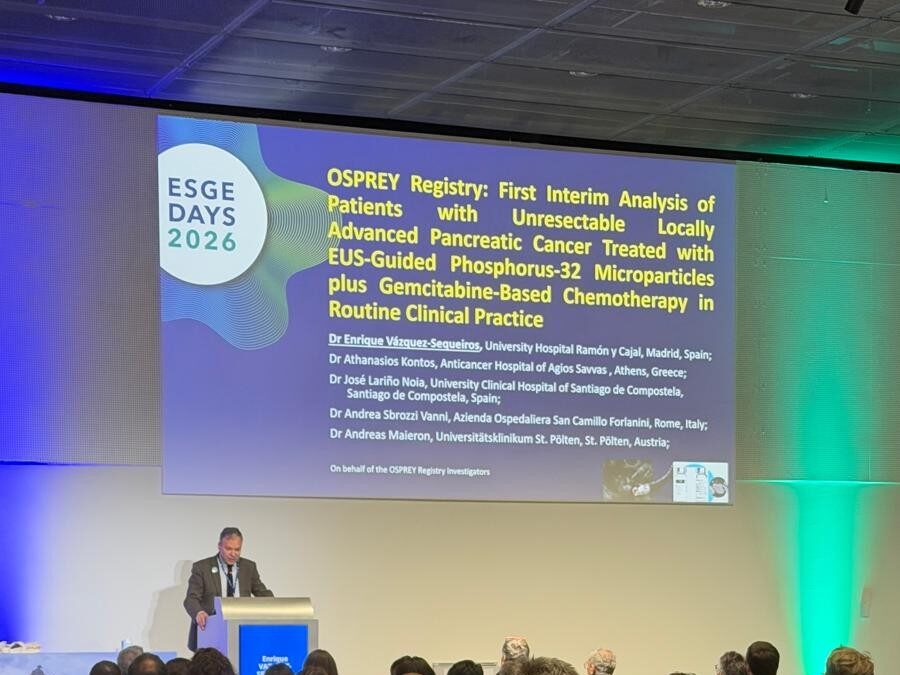
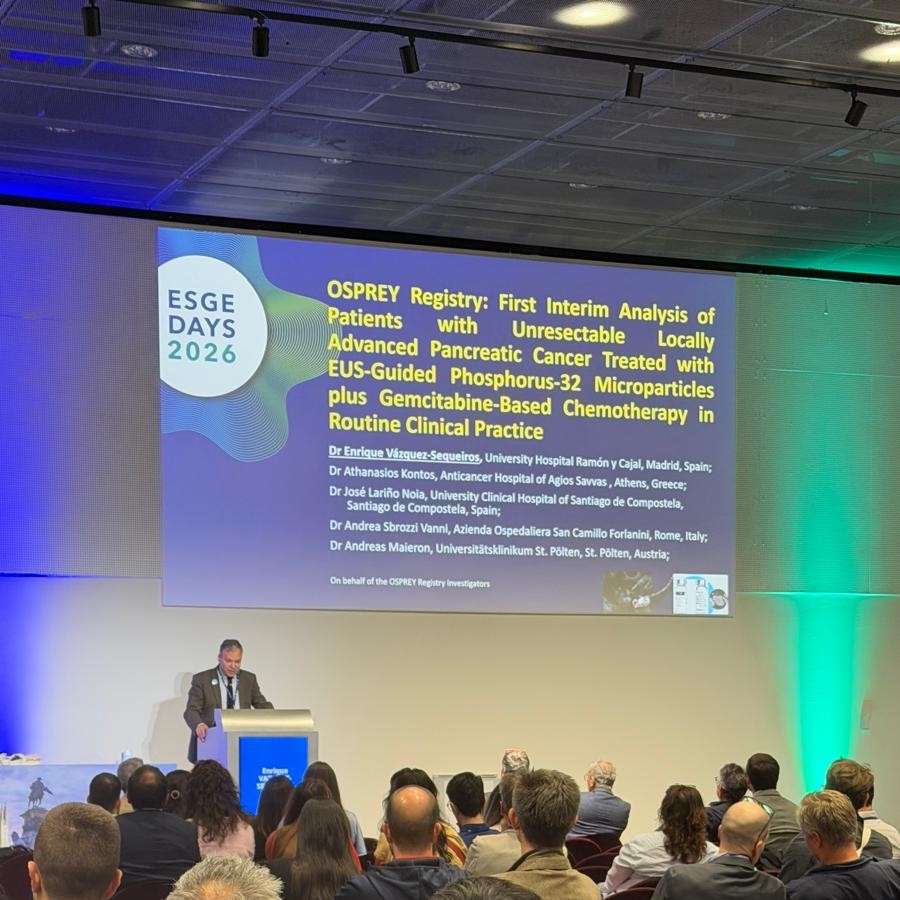
The presentation, titled “OSPREY Registry: First Interim Analysis of Patients with Unresectable Locally Advanced Pancreatic Cancer Treated with EUS-Guided Phosphorus-32 Microparticles plus Gemcitabine-Based Chemotherapy in Routine Clinical Practice”, was delivered by Dr Enrique Vázquez-Sequeiros from University Hospital Ramón y Cajal, Madrid, Spain, on behalf of the OSPREY Registry Investigators.
The OSPREY Registry is a post-market, multi-centre, observational and prospective registry evaluating the safety and effectiveness of OncoSil™ in real-world clinical settings. As of 1 August 2025, the OSPREY Registry had enrolled 64 patients across Austria, Greece, Italy and Spain, with total enrolment now exceeding 80 patients.
Key Interim Findings
The interim analysis demonstrated:
- Strong safety profile with adverse device effects (ADEs) reported in 15.6% of patients, consisting
primarily of mild Grade 1 abdominal pain and one Grade 2 fatigue event. Importantly, there were:- No Grade ≥3 ADEs; and
- No serious adverse device effects (SADEs).
- Encouraging efficacy outcomes, including:
- Local Disease Control Rate at 12 weeks post-implant was 91.4% in patients receiving first-line chemotherapy and 77.8% in patients receiving second-line chemotherapy.
- To date, 7 patients have undergone surgical resection with curative intent following treatment with OncoSil™, including 3 patients implanted within ≤4 months of commencing first-line chemotherapy, 3 patients implanted between 4–12 months after commencing first-line chemotherapy, and 1 patient implanted within ≤4 months of commencing second-line chemotherapy.
- Of the 7 surgically resected patients, 5 patients (71.4%) achieved an R0 resection margin and 2 patients (28.6%) achieved an R1 resection margin.
- Median overall survival results included:
- 20.6 months for patients implanted within ≤4 months of commencing first-line chemotherapy;
and - 22.0 months for patients implanted between 4–12 months after commencing first-line
chemotherapy.
- 20.6 months for patients implanted within ≤4 months of commencing first-line chemotherapy;
The investigators concluded that the addition of EUS-guided implantation of OncoSil™ phosphorus-32 microparticles to gemcitabine-based chemotherapy in routine clinical practice for patients with LAPC was safe and well tolerated, with a limited number of anticipated ADEs experienced and no SADEs or Grade ≥3 ADEs reported. OncoSil™ appears to provide local disease control, downstaging to surgical resection in a proportion of patients and encouraging overall survival.
The interim findings from the OSPREY registry demonstrate a highly encouraging overall survival profile for patients with unresectable LAPC treated with the OncoSil™ device in routine clinical practice. Historically, prospective clinical trials evaluating first-line gemcitabine plus nab-paclitaxel alone in patients with unresectable LAPC have reported median overall survival ranging from 12.7 to 18.8 months.123 In this context, the median overall survival of 20.6 and 22.0 months observed in first-line patients enrolled in the OSPREY registry represents a notable improvement over historical benchmark.
Nigel Lange, CEO & Managing Director of OncoSil Medical, said:
“The presentation of the interim OSPREY Registry results at ESGE Days 2026 is another important milestone for OncoSil and provides further validation of the encouraging clinical outcomes previously observed in our earlier studies and clinical data. Importantly, these results demonstrate that the safety profile and efficacy outcomes associated with OncoSil™ can also be achieved in routine real-world clinical practice across multiple centres in Europe. Seeing consistent disease control, encouraging survival outcomes and downstaging to surgery in selected patients in a real-world setting further strengthens our confidence in the role OncoSil™ in the treatment of unresectable locally advanced pancreatic cancer.”
Dr Enrique Vázquez-Sequeiros from University Hospital Ramón y Cajal, Madrid, Spain who presented the interim analysis at ESGE Days 2026, said:
“Presenting the first interim analysis of the OSPREY Registry at ESGE Days 2026 is an important milestone in demonstrating the real-world potential of the OncoSil™ Device for patients with unresectable locally advanced pancreatic cancer. These multicentre European data show that treatment with OncoSil™ alongside gemcitabine-based chemotherapy is safe, well tolerated, and associated with encouraging disease control, downstaging to surgery in selected patients, and promising overall survival outcomes. We believe these findings further support the role of OncoSil™ as a valuable addition to the treatment pathway for this highly challenging disease.”
References:
- Cascinu S, Berardi R, Bianco R et al. Nab-paclitaxel/gemcitabine combination is more effective than gemcitabine alone in locally advanced, unresectable pancreatic cancer – A GISCAD phase II randomized trial. Eur J Cancer. 2021 May;148:422-429. doi: 10.1016/j.ejca.2021.02.023.
- Babiker HM, Picozzi V, Chandana SR et al. Tumor treating fields with gemcitabine and nab-paclitaxel for locally advanced pancreatic adenocarcinoma: randomized, open-label, pivotal phase III PANOVA-3 study. J Clin Oncol 2025. doi:10.1200/JCO 25-00746.
- Philip P, Lacy J, Portales F et al. Nab-paclitaxel plus gemcitabine in patients with locally advanced pancreatic cancer (LAPACT): a multicentre, open label phase 2 study. Lancet Gastroenterol Hepatol 2020; 5: 285–94, doi: 10.1016/S2468-1253(19)30327-9.
Related articles
OSPREY Registry Interim Results
Read more ...